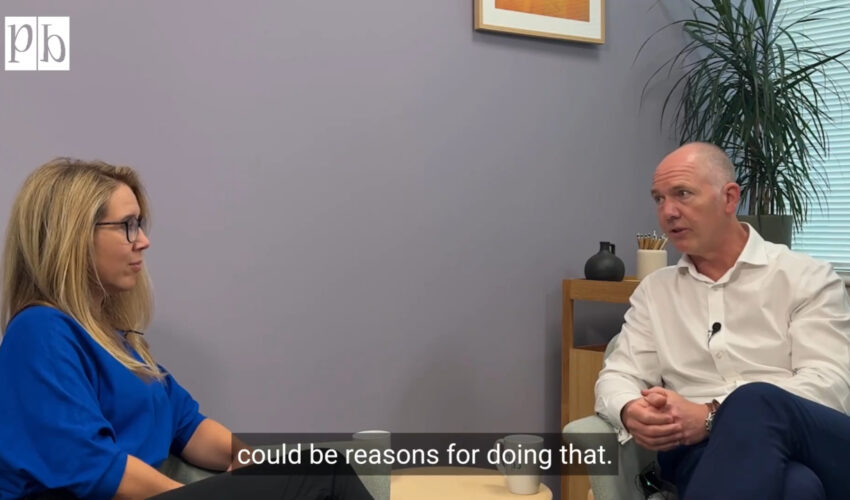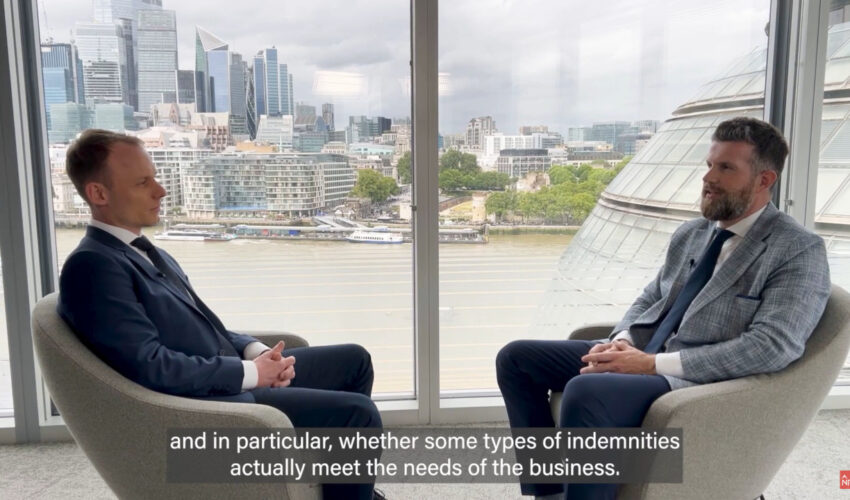
Marc Harris is joined by Simon Barker, Partner & Head of Intellectual Property (IP) at top tier law firm Freeths, to discuss how (IP) acts as a powerful business enabler by protecting innovations, creating competitive advantages, attracting investment, and generating revenue through licensing, turning intangible assets into tangible value for growth, market positioning, and resilience.
Q 01: Let’s start with the basics. What is Intellectual Property, and why should businesses care about it?
Q 02. What are the main types of IP, and how do they differ?
Q 03. Why is registering IP so important? What are the risks if a business doesn’t?
Q 04. Does the act of registering IP act as a deterent to other businesses?
Q 05. How many companies do you think might have IP that they haven’t properly registered?
Q 06. How can an IP audit and strategy add value to a business?
Q 07. Can IP really act as collateral to help a business raise finance?
Q 08. How is the value of IP measured?
Q 09. How else can companies monetise the value of their IP?
Q 10. What are the risks of IP infringement, and how do they arise?
Q 11. What should a business do if it receives an IP claim?
Q 12. How much of your work Simon is dealing with contentious issues compared to registering of IP?
Q 13. Can you share a real-life example of how your department helped a business overcome an IP challenge?
Q 14. What are the first steps a business should take if they believe they should be addressing their IP?
Q 15. How does IP work when a company pays another company, or indeed an employee, to delevop a solution?
Q 16. By working with Freeths I assume that your clients benfit from Freeths’s entire set of joined up services?
Q 17. What’s the one piece of advice you’d give to any business about IP?
Intellectual Property to Drive Growth, Access Funding and Improve Resilience
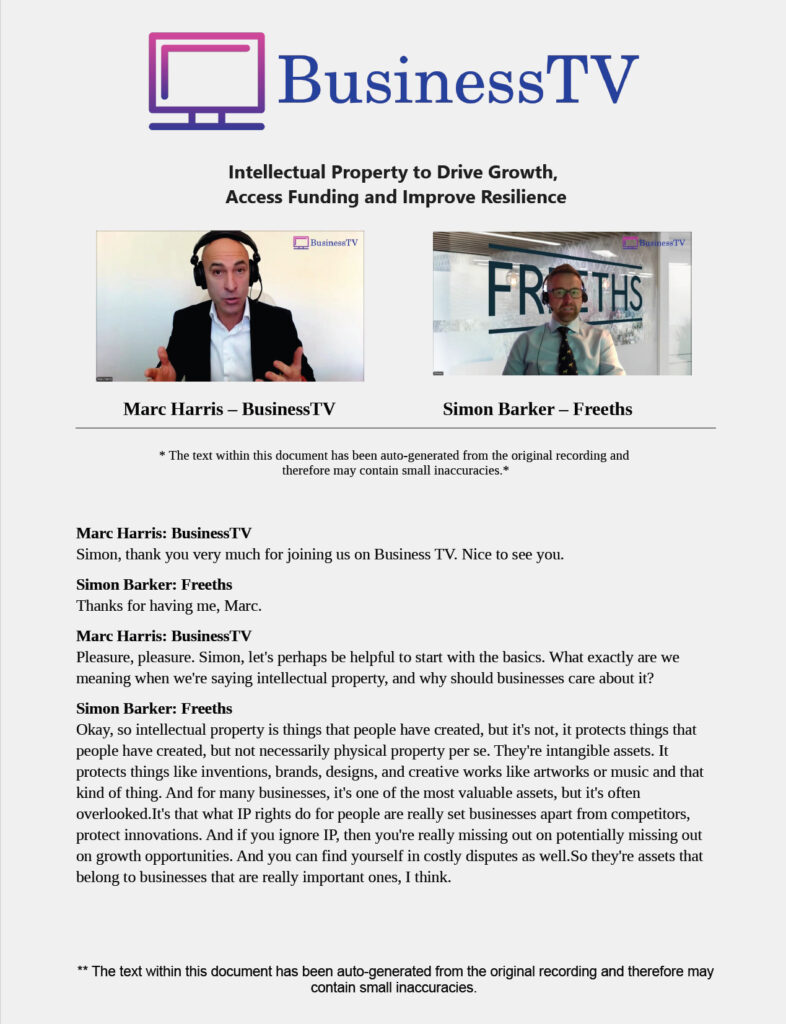
Intellectual Property to Drive Growth, Access Funding and Improve Resilience
*The text within this document has been auto-generated from the original recording and therefore may contain small inaccuracies.
Marc Harris: BusinessTV
Simon, thank you very much for joining us on Business TV. Nice to see you.
Simon Barker: Freeths
Thanks for having me, Marc.
Marc Harris: BusinessTV
Pleasure, pleasure. Simon, let’s perhaps be helpful to start with the basics. What exactly are we meaning when we’re saying intellectual property, and why should businesses care about it?
Simon Barker: Freeths
Okay, so intellectual property is things that people have created, but it’s not, it protects things that people have created, but not necessarily physical property per se. They’re intangible assets. It protects things like inventions, brands, designs, and creative works like artworks or music and that kind of thing. And for many businesses, it’s one of the most valuable assets, but it’s often overlooked.It’s that what IP rights do for people are really set businesses apart from competitors, protect innovations. And if you ignore IP, then you’re really missing out on potentially missing out on growth opportunities. And you can find yourself in costly disputes as well.So they’re assets that belong to businesses that are really important ones, I think.
Marc Harris: BusinessTV
Can you sort of give us some examples of different types of IP then, and of course, you know, how they might have one type of IP might differ?
Simon Barker: Freeths
Sure. So there is a sort of bucket load of IP, really. Perhaps the most familiar to people would be things like trademarks, or make other things like brands, which we’re all familiar with, because they’re everywhere around us. So brand names, logos, the sort of things that you see on luxury goods, but not the preserve of luxury goods. They’re all protected by trademarks, and they’re registered rights that you can acquire and own. So they’re really important intellectual property rights. Other intellectual property rights cover design. So you can have registrations around designs, which is the shape or appearance of a product, the sort of lines, contours, it can even protect the surface decoration. So everyday items, you know, that you see, iPhones, mugs, you name it, are all designed and covered by designs in one shape, shape or form or another. Patents is another area of protection, and that they tend to cover inventions, things that solve technical problems, that kind of thing. Copyright is another area, and that’s an area that covers really the creative works, if you like. So artworks, music, literary works, books, of course, could be sculptures, can even be architecture. So copyright is a really broad intellectual property right. And then you’ve got things that are not, not perhaps immediately obvious, but things like confidential information or trade secrets that business might have. They may not be disclosed to the world, but they can still be treated as really important intellectual property assets within a business. And those sort of things might cover, you know, secret recipes or algorithms in a tech products and that kind of things, logic trees and ways of doing things. But each intellectual property right, as the law sees them, covers different, gives different protections to different things, and therefore has different benefits. And understanding all of them is really important to unwrapping the value of IP in a business. Does that help, Mark?
Marc Harris: BusinessTV
Absolutely. So really what you’re saying is, is that even a company that doesn’t necessarily make anything novel or hasn’t got a design, but they may have a, maybe their company name, or it might be their logo. It might, could even be their domain name, which all could theoretically constitute some sort of form of intellectual property for the business that might warrant protecting.
Simon Barker: Freeths
Absolutely. Every business will have intellectual property of one sort or another. Different intellectual property rights will be more important to some businesses than others, just depending on the nature of the business.
Marc Harris: BusinessTV
Why is it so important to register the IP? Because perhaps a lot of businesses might think, well, you know, if I, if this is my company name and that’s what I’ve registered at company house, and I’ve bought my domain name, then all of my rights to that are sort of implicit perhaps. So sort of why is it really important to make sure that you’re locking down those IP rights that are important to your business? And what are the, what are the pitfalls if you don’t?
Simon Barker: Freeths
So intellectual property rights, particularly where you, where you, where you register them, give you a legal right to stop other people doing, using your IP basically. And that’s the value of them. That’s the thing that preserves a monopoly in, in, in, in what it is that you’re seeking to protect really. So, you know, you know, and that can be really important for some businesses in different, different contexts. There’s a traditional context of really, you know, dealing with people who are, who are very clearly infringing on your, your rights or copying your products or things like that. But, but you make a good point about online businesses and, you know, it’s not just the preserver of goods. It is also the preserver of services. So you might be offering a service online that could be, in respect of which your brand might be really important. And if you’ve registered, you’re registering your trademark, for example, in that context can be really, really important because if you want to make complaint to different complaints to different platforms, about maybe an infringement by a third party in relation to your brand, having the registration can be really important because many platforms online marketplaces and things like that won’t accept those complaints unless you can demonstrate that you own, own the rights. So that’s just one example of where practically the registration of a trademark, for example, could be really important, say to a service business online, not just somebody selling goods.
Marc Harris: BusinessTV
The fact that you’ve got these things registered already demonstrates your, your intent to follow things through if you do become aware of an infringement.
Simon Barker: Freeths
Yeah, certainly. So, so certainly registered rights are things that, you know, third parties can actually see that are registered and that may operate as a, as a disincentive to people. If that’s, that’s your point.
Marc Harris: BusinessTV
Yes.
Simon Barker: Freeths
Yeah. With, with, without, I mean, and there’s the other point, I suppose, without that registration, other people could actually look to sort of claim things for themselves, whether it’s your brand or, or your, or invention and all of these things result in lost sales or reputational damage, you end up having a fight about them, which ends up in legal costs, which is not something people really want to be investing in necessarily. So, so yeah, I mean, I think, I mean, there are so many reasons why intellectual property rights are important and the benefits of registration outweigh sort of not thinking about it at all.
Marc Harris: BusinessTV
Out of 10, 100, 1000 businesses, how many do you think have done a full investigation of their IP? How many, how many businesses do you think have everything locked down as well as they might?
Simon Barker: Freeths
I think firstly, your point about there being so many more sales channels and opportunities these days is a good, is a good point, because that does, you know, it does, it is an imperative to actually think about these things a little bit more, but to answer your question about how many people have actually really given it as much thought as they might have done, then yeah, sophisticated businesses will, but whether they’ve gone to the extent of sort of properly, fully auditing their IP, probably not because they probably just focus on what they see is the most relevant to them. You know, I think there is merit in actually thinking a little bit more broadly than that. So it’s usually when people come to do it, it’s usually prompted, but for some reason, maybe it’s after the event when somebody’s infringed, and it’s the experience which drives the renewed interest, or it’s, you know, a capital event on the horizon, it could be investment, it could be sale, it could be, you know, that sort of thing, and then all of a sudden it becomes, it comes into focus. The value in doing it earlier is you get ahead of some of those things before an infringement happens, or before you end up realising you’ve got problems that are standing in the way of maybe sale or investment or that sort of thing. So I think people don’t always think about these things until something happens, but they really should. They really should. I think it’s a good point. Yeah, for sure. Yeah.
Marc Harris: BusinessTV
I think most people can understand the importance of registering IP so as to protect themselves against infringement from another company, either acting in bad faith or simply perhaps even not knowing that they are making an infringement. You mentioned briefly there how IP perhaps often only gets looked at when a business is, when perhaps a business owner is looking to sell or do other things. Talk a little bit, would you, about how undertaking a full IP audit and then locking in IP rights as and when you can as a business, talk to us a little bit about how that supports, how that works as a business enabler, how it might support either, you know, a sale, for example, or indeed a company looking to raise finance, which I know is sort of increasingly, an increasingly popular strategy these days.
Simon Barker: Freeths
I guess getting back to the idea of the IP audit, it’s a useful thing to do because what you’re doing in that is identifying the intellectual property assets that you have. You’re looking at where there are gaps in protection, things that you could fill or that you need to fill from the point of view of what, you know, the business’s current position or its strategic goals. And you’re also identifying risks, the sort of thing that a buyer or an investor might look at and think, oh, I’m not sure about that. So, you know, identifying the risks enables you should deal with the risks ahead of time. So, that’s really sort of two major points around IP audit. It’s about, have you got things protected where you need them to be protected? And if you really, if you covered off any risks or other gaps, could be usually things like, do we properly own the rights that we think we, that we own, that kind of thing. And then I think there’s always a strategy piece that goes alongside this, which is to what extent does the IP that you’ve got or identified or that which you might need align with that, align with those business goals, whether that is growth, because it’s not always about a sale or an investment opportunities, it’s about actually building a business. So, does your IP strategy align with your business goals, whether that’s growth sale or even new markets? The point of the IP audit is, you know, you can uncover hidden value as well as preventing costly mistakes later. You know, if you find out you haven’t got the rights for example. And, you know, and actually having done an IP audit and taking these things seriously and being able to demonstrate that to an investor or buyer in that context is really valuable because it shows that you’ve taken the care and you understand it. And, you know, if you do and turn all the stones and all of that stuff, then there’s an inherent value in IP. So, that’s got to be good from the point of view of investment and or sale, of course, because if you’re selling your business, you want the highest price, right? So, an IP audit can actually help you underline that.
Marc Harris: BusinessTV
And indeed, if you’re looking for a speedy sale and you find a buyer, but then the last thing you want is then the buyer requiring you to have locked in IP rights that have been overlooked before a transaction is actually made, which then might delay things another three months and by that time they’ve got cold feet. So, yeah, there’s lots of sensible reasons to do it in that respect. And I think that is very interesting, just making sure that you are underpinning the value of the business. And then when it comes to raising finance, is that really something that can happen? I know that a couple of the sort of big lenders out there in the market were making some noise about loaning against decent IP rights. This was about a year ago. I haven’t kept a close eye on that myself. I don’t know what your experience, what your thoughts are about that or, you know, have you had clients that have been successful in raising finance against the IP that they’ve generated?
Simon Barker: Freeths
Yes, I’ve seen that IP can be used as collateral for loans. As a team at Freece, we look at it from both sides. So, we have a banking team that look at it from a lender’s perspective. And we also look at it from a business perspective. So, we understand both sides of the coin there. Yeah, they’re securable assets. And again, understanding what assets you’ve got there and what you can essentially schedule comes back to the IP audit, really. You know, you’ve got to be able to identify these things in order to borrow against them. But I think, you know, there is a trend for that.
Marc Harris: BusinessTV
How is it determined what value that IP might have? Because, of course, I suppose at some point, somebody’s got to be able to say, well, it’s worth this much potentially, and therefore, we can borrow X against it. That must be quite an arbitrary process. Or are there ways in which you can go about assessing what the real market value of something might be?
Simon Barker: Freeths
Okay, so through different factual scenarios there, you know, you could be looking at somebody who’s investing in a business that would be, you know, wanting to understand what the IP and everything is. And probably in the scenario that you’ve outlined, we want to see maybe a patent application or something like that, or some design registrations. It may not be a bank loan, it might be an angel investor or private equity or some of the funding, different things. But if you’re talking about bank loans, or actually raising finance by way of security over IP, then usually in that context, you’re looking at the IP valuation, which I think is what you’re getting at. It would usually be the lender that would be looking at that, and they’d be working with IP valuation experts to understand what that is. You would typically look at it in different ways. You might look at what the market value is for the IP, and IP valuation experts will look at comparables and things like that. If it’s the sort of IP that generates revenue, so music licencing would be a good example of that, but not necessarily, then you look at income streams and things like that. And then another way of looking at valuation would be the actual cost of the IP itself, if you like, and typically IP valuation experts will look at sort of that, those three kind of things and come up with a valuation. But it would be done on the lender side, obviously, from an advisory perspective, you’d want to obviously make sure that it’s stacked up commercially, and that you’re satisfied that you’re getting the right kind of loan facility in return for it. But that’s broadly speaking, how it works.
Marc Harris: BusinessTV
The fact that that term even exists, IP valuation experts, kind of answers my question. I didn’t know how that sort of unfolded, but it would make sense that there would be a specialism out there of people who are expert in evaluating that IP. And I suppose that’s very often those sort of people are working in kind of quite specific verticals, so somebody might know a lot about valuing the IP of products in a particular area. But no, that makes sense, and it’s an interesting area.
Simon Barker: Freeths
It’s not the only way that people raise money through IP, though, because it happens as part of different businesses and business models. So coming back to the licencing point, some businesses generate revenue just by licencing IP. I’ve given some examples of that, but it could be any licencing of IP or any of the rights that we’ve talked about. Virgin made money out of licencing the brand itself. You’ve got people who will licence patents to other businesses for whom the technology might be important. The value of licencing IP as a means of generating revenue can sometimes be that it doesn’t come with any manufacturing or marketing costs, because you’re basically just giving it over to somebody else in return for a royalty strain.
Marc Harris: BusinessTV
So that’s another compelling reason to get your IP rights locked down in the first place, isn’t it? Because if at some point a business might want to pack up shop because they don’t want to deal with the running costs anymore, but nonetheless retain the IP rights for something that they’re no longer interested in producing, that’s an ongoing revenue stream for whoever it is who owns that IP.
Simon Barker: Freeths
Certainly, that’s another scenario that you come across. Yeah, absolutely. There’ll be other means of exploiting IP. Again, it depends on the business. Say, for example, somebody who owns the rights in a consumer good, for example, they might have a market here in the UK or in Europe, but they might want to expand into new markets in different territories around the world. Having the IP around those things, and IP tends to be a geographical as well, so you have to have rights in different territories.Securing the rights in different territories potentially opens up the ability to work with others in partnerships to exploit the IP in those other territories and thereby derive revenue that way. Typically, brands will exploit that by appointing distributors in different territories. You sometimes see IP exploited in franchise arrangements as well, but the way in which a rights holder is able to control that and derive that expansion and that extra revenue is through owning the IP rights because that’s the only way that you can control that kind of exploitation in other territories, for example. Then, looking at the other way, you’ll have businesses that will licence in IP, which is the other side of the coin, as a means of sort of speeding up innovation and getting ahead without all the investment cost on development, which we touched on earlier when we talked about licencing in a rights. You can licence out and you can licence in.
Marc Harris: BusinessTV
It makes perfect sense now that you explain it all, Simon. I suppose sometimes it must be quite an interesting process for a company who might be going down the road of doing a full IP audit simply because maybe they want to take the business to sell in a few years or they just think it’s a good idea to do so for the right reasons, which of course it is, but as they do that and learn about the value of what they have, they may well then, as that process unfolds, become aware themselves of ways in which they can exploit it that they hadn’t really thought about beforehand, you know, other revenue streams or territories that they could be entering into with distribution partners or sales agents that perhaps hadn’t occurred to them beforehand. So that’s another great and compelling reason, isn’t it? So very fascinating. So kind of what you’ve just said leads me nicely on to my next question actually, because we’ve spoken so far about why you want to lock in IP rights, why as a business you want to register your IP, wherever that might be, to protect yourselves. Let’s also talk about something else called IP infringement then, because this is, or perhaps you can explain to us what IP infringement is, because you kind of sort of, we’re about to sort of start mentioning that, I think, in what you were just saying, but this is when a company might unknowingly infringe upon another business’s IP rights.
Simon Barker: Freeths
You’re protecting your own rights just to prevent other people from infringing on your rights or to control the rights and make money out of them in different ways, but what are the risks if you, what are the risks you run if you’re potentially infringing third-party IP rights or other people’s IP rights, which I think is what you’re getting at, Mark. That can be a real problem and that’s sort of born out of an ignorance around IP in a different sense, because you’re right, if you find yourself using things that, so let’s take the brand example for a minute. So you launch a new product under a new brand or whatever and you do that without really thinking about it, the risk is that you might find yourself infringing on somebody else’s intellectual property rights or trademark rights in that context. You might be developing a new product that solves some technical problem or is designed in a certain way to be appealing to consumers, you know, have you considered whether or not in doing that you might be infringing on somebody else’s registered designs or patent rights, particularly if there’s a technical solution there, and the way you mitigate, I mean the risks are quite great aren’t they, because we’ve talked about IP rights enable rights holders to prevent people from infringing on their IP and the risks there are you get sued, you have to pay damages, you might be injuncted from doing what it is that you want to do, which could be costly because you have to start from scratch and you lose all of the investment you might put into it. Those are the kind of, you know, practical risks. How you go about preventing them is really being mindful of that risk, understanding that third parties might have intellectual property rights and coming to people like ourselves to say, you know, I want to do this, can we just check that there isn’t any other rights out there that, you know, we might be infringing, and you do that through clearance searching against third-party trademarks, you do it against freedom to operate searches around patents and things like that, so I guess the message is if you are launching a new brand or a new product or looking to develop one or whatever, have a thought to intellectual property because not only will you want to protect it for yourself, but you want to make sure that you don’t infringe on anybody else’s rights, and for those two reasons it’s worth just looking at doing some searching and checking out and trying to assess what that risk might be, if any.
Marc Harris: BusinessTV
If, for example, a company is presented with a wonderful opportunity to wholesale a product here in the UK market, a product that comes from overseas, they might well decide to seek professional help if it’s going to represent a considerable investment to them to implement those sales channels and that distribution process, they may well think to themselves, well, I’d better just make sure that the company that I’m working with has got those rights in place, allowing me to use them, or if I’m doing something new myself, I better make sure that I’m not infringing on IP rights that already exist out in the marketplace.
Simon Barker: Freeths
Yes, so you make a good distinction there in that I was talking about developing something for yourself, but of course you’re right, if you’re buying in goods from abroad for resale here, then you’re the person who’s going to be sued if it infringes on anybody’s third-party rights.Usually you’d hope you’d see some kind of indemnity in the supply contract, so that you could pass any liability back to the supplier, but of course that’s only as good as the paper it’s written on if there’s no money behind it. Certainly where people source goods from sometimes there’s no hope in hell of actually recovering under indemnity. So yeah, you probably do want to be asking the right questions. If you’ve got concerns, you want to be asking the right questions about, you know, is this likely to be a problem? Are there any patent rights? But those are due diligence questions you’d want to ask of a supplier, but you might seek professional help as well from somebody like ourselves.
Marc Harris: BusinessTV
What does a business do if they do get into that awful situation where they receive a claim, either because they’ve not done their due diligence on a company whose goods they’re selling, or because they’ve decided to embark upon a novel project themselves, but hadn’t done their due diligence in terms of seeing whether or not anybody else had already had that idea and was commercialising it? What do you do?
Simon Barker: Freeths
These things happen. They happen to the best of businesses. Don’t panic. These things are always capable of resolution. Take legal advice immediately, because if you get in early, the objective would be to try and nip things in the bud so far as you can. Gather and preserve all the relevant documents and evidence. That’s really important. You need to have everything to hand. Again, don’t panic. Most claims are resolved through negotiation or settlement, but acting quickly is really important because you need to understand fairly quickly what the best and worst case scenarios are and get a strategy in place for resolution. That’s where professional help really can add value. What I often see is people try to sort it out themselves. It drifts, and then they’re somehow in a worse position because they might have made an admission, implied or otherwise. Early action saves time and money. Our job as lawyers is to focus on the most cost-effective resolution, whatever that might be. But that means thinking about a strategy really and implementing it properly.
Marc Harris: BusinessTV
What sort of proportion of your work is done with helping companies at the outset do the things properly and look at their IP and get all their ducks in a row, as it were, and what portion of your work is companies coming to you saying, Simon, I’ve got a right mess on my hands. I’ve just received an IP claim. What do I do? Please help. Is it sort of 50-50 or is one more common than the other?
Simon Barker: Freeths
It’s a real mix. We offer a one-stop shop at Freece. We do everything from filing and prosecution for registration of rights, trademarks, patents, registered designs. We do quite a lot of work at the front end, the protection end of things as well, but we’re also very well known for dispute resolution. People will come to us for claims as well. Then we act very often on the transactional side of things, so in the context of business M&A transactions and that kind of thing, and again, talked on sometimes lending and things like that. But we do everything to do with IP. It’s difficult to answer your question really, because it’s a real mix of different types of work within that legal context. Of course, because as we said at the beginning, IP covers pretty much every business and sector in one way or another. It’s different horses. It’s horses for courses. If you’re acting for a certain type of business, that business might be at more risk of IP claims. Another kind of business would be on the other side of the fence. It’s a real mix of everything, to be honest. That’s, I think, one of the things that’s really helpful for clients, because it means that we’ve seen pretty much everything from all sides, if that makes sense.
Marc Harris: BusinessTV
Yes. Just to let viewers know, we’ll perhaps speak about it more at the end of the conversation, but you three really are a full service agency. You do everything, don’t you? I know. Before you and I agreed to have this chat, we were looking at the variety of services that you help businesses with all elements of IP. Give us, if you would, because our audience always likes real-world examples. Can you give us a recent real-world example of any kind of IP challenge that you’ve helped a client overcome?
Simon Barker: Freeths
One of the probably the most well-known and popular kind of IP disputes that we were involved in was the Colin the Caterpillar and Cuthbert dispute. So we helped Cuthbert, this was to do with Caterpillar cakes if you remember with Marcellus Spencer’s and Aldi. So we helped Cuthbert in that case and that was with the benefit of hindsight quite entertaining. So that’s an example of an IP infringement case in a retail context where we got involved. But we genuinely do work across lots of different sectors. So I work for automotive parts manufacturer who regularly have to deal with counterfeit issues. Wasn’t that long ago we were in court injuncting somebody in the northeast who was producing counterfeit parts. You know that’s in the more sort of the infringement arena is more headline worthy attractive in that sense.
Marc Harris: BusinessTV
But as the world becomes smaller as well I mean all of the it just must be I mean it’s not only a huge complex area but it’s of course potentially depending on where the company operates I mean it’s completely international isn’t it. An IP infringement can literally come from anywhere it could come from 20 miles up the road.
Simon Barker: Freeths
Yeah so we do help businesses that operate globally. I mean I can think of you know there was two. So this illustrates your point about what how many what sectors benefit as well. So you know we talked about automotive though we talked about retail. You know in the kind of IP audit space pre pre-sale we acted for a pretty well-known household product with a strong brand and did what is essentially an audit for them. Identified some gaps in territorial protection particularly around the around the brand and filled those before a sale which happened a couple of years later. But that goes to your point about it being sort of and be can be global. But in that context also there were ownership issues around software and some domain names as well which needed to be sorted out. Not none of that is unusual if you come across businesses you’ll always find something. But again it illustrates for you I guess geographical scope points that the number of different sectors and when we operate you know we got clients in the manufacturing sector as well. You name it.
Marc Harris: BusinessTV
You do everything. Yes because I was going to ask you what sort of sectors are affected more than others. But with it being such a broad subject and everybody thinks about manufacturing because everybody thinks about a patent on a novel innovation don’t they. So everybody sort of understands IP from that perspective.
Simon Barker: Freeths
But luxury goods and fashion we do some stuff particularly in the anti-counterfeiting space. So we’ll do border control for a number of luxury brands that are fashion brands essentially. So we post Brexit you have to you have to you have to have a UK one as an EU one and you basically educate UK border force about all of the different IP rights that sit around that particular client’s brand so that they can deal with seizure of counterfeit goods. So there’s just another example of you know IP services for a particular sector. Obviously perhaps it’s more relevant those services are perhaps more relevant to a fashion client than they are to some others. But not necessarily it’s every sector it’s fashion consumer goods tech media manufacturing pharmaceuticals sometimes. Any business with a brand product or some innovation it’s IP is literally everywhere.
Marc Harris: BusinessTV
Yeah and it even these days I think even comes down to things like working methods doesn’t it and I know trade secrets are a big sort of component as well. So companies have got very perhaps novel ways in which they simply do things and that in itself is a market advantage and they don’t want perhaps exiting employees going walkies with that information they’re taking that to a competitive and again that’s all IP too isn’t it that’s all things that you can that a company can think about.
Simon Barker: Freeths
Yeah yeah and data is increasingly important.
Marc Harris: BusinessTV
And data and data…. sorry go on.
Simon Barker: Freeths
I can think of an IP audit that we did not that long ago for a business where you know you look traditionally it was a business that employed software and hardware in a particular in a particular way. I won’t go too much into the application because it’s confidential but we did an IP audit for them and looked at all the different components of what their service and the products and the product is a product and service business that they offered. And so we’ll actually you know thinking about it actually there’s probably quite a lot of a lot of value in the data that you’re collecting and that prompted a conversation which then you know helped them think about different different ways of maybe making making money which is which is what business is all about.
Marc Harris: BusinessTV
So right right yeah absolutely again going down that exploratory path and then becoming aware of revenue streams that perhaps one hadn’t even thought about but only becomes aware of once you realise that oh if there’s some if there’s a value to that then that means that there’s going to be a value to that to somebody else. So yeah fascinating.
Simon Barker: Freeths
Often they’re just really good conversations.
Marc Harris: BusinessTV
Yeah yeah it’s a very it’s a very interesting area of work that you’re involved in if a business is which is probably unlikely but of course somebody will be listening to this conversation and thinking okay well I really haven’t done any of this or I did a little bit a few years ago when it came to registering a you know a name for our product but listening to Simon speak I can think of perhaps lots of other things that we should do as a business. What are what are the first steps that a company can take Simon? I mean what do they what do they need to do? Do they need to give it much thought or do they just pick up the phone to you and your team and say look can you come in and let me tell you all about my business and you can tell me what IP challenges you think I might have?
Simon Barker: Freeths
Yeah I mean to be frank with you that’s one of the things that I really love about my job. It’s the breadth of people that we work with understanding you know getting to learn about new businesses and what makes them tick and what the opportunities are that I find just really interesting. Yeah often it’s just a it’s often it’s a conversation and always open to have conversations with people about what they do and what they want to achieve. Sometimes that results in saying look let’s undertake a bit of an audit other times it’s very clear that it’s not you know that that might not be necessary but for a lot of people it is. Let’s understand what we’ve got what might help. So I’d say yeah have the conversation think about whether or not an audit is a is the right thing for you. Think about whether or not you’ve got things registered properly. Have you got we haven’t talked much about contracting with third parties as well but contracts is really important in IP as well so if you’re working with third party creators or we talked about licencing in the context of people you might be allowing to use or licencing and it’s really important that you get those IP contracts properly in place and so when we talk about an IP audit it’s not always about just what the IP rights are per se but it’s also about understanding what the contractual arrangements are with people that touch on IP. So that’s really important if you are a rights holder and you want to protect yourself and make sure that you’re defending yourself in the market against infringements then we offer lots of monitoring type of services as well that would be worth giving thought to. That’s watching out for people infringing on your brand, company names, various different different things we talked about border control for some businesses that’ll be really important.
Marc Harris: BusinessTV
When you use the word contracting that if I was that business paying another business to develop something for me I need to be very clear that what they are being paid to develop for me becomes mine at the end of the day and they’re not holding any right is that what you meant?
Simon Barker: Freeths
Yes that’s what I’m getting at. It’s about making sure that the IP rights are dealt with in that contract. There are different ways in which it can go depending on the commercial circumstances so it could be ideally often for somebody who’s contracting those kind of services it would be want to own all of the IP that subsists in whatever it is that is created but it might be that if that’s not possible because say if it’s software for example often software developers don’t like to transfer the IP but you want to make sure that you’ve got all of the rights you need to use it and that it’s not going to cost you more in the longer term. So often where people have been commissioned to produce things you know very basically it could be a piece of artwork or a brand or whatever and where the ownership of the rights and that created content or whatever it might be is not dealt with lands in a problem later because the ownership position isn’t clear. So you’re right to pick up on it it’s all of those interactions particularly if you’re commissioning people you need a contract in place and that needs to do with the IP one way or another one way or another.
Marc Harris: BusinessTV
And does that also percolate down to employee contracts so for perhaps full-time staff who are working for the company who perhaps part of their job is to try and think through problems and come up with novel ways of solving a problem. I mean potentially I guess that all comes under the broad title of IP that one would want to retain in the company.
Simon Barker: Freeths
Yes so employees have a slightly different position and the general position in English law is that the rights that are credited by an employee in the course of their own employment are invested in the employer. There are some options things like rights to compensation in really valuable patents and things like that but generally if they’re an employee and it’s in course of their employment then the rights will vest in the employer. So that’s less of an issue it’s more it’s more the context where you’re employing a consultant or a contractor to produce things for you. And it’s not just about having it’s about having the ownership and if you don’t have the ownership and it’s the rights then you need to think about who might own the rights and any registrations of the IP. So again that comes down to what is the IP and how important is it and you know it’s the principle is there but the detail can be quite complicated. So it’s worth and very often those are the things that get unpicked in corporate transactions M&A transactions things like that where you go through due diligence exercise you find that there’ll be things that have been created but the ownership has not been dealt with. So it’s another reason for the IP audit sort of approach up front but better to have an IP strategy and policy and policies in place. If you’re a sophisticated business you do that and then you don’t find yourself in that position because you look at your contracting properly.
Marc Harris: BusinessTV
Yeah I mean obviously the advantage of working with a firm like yourselves or you and you and your team is that if one comes to you for help with a particular IP challenge then of course it’s a natural step for you as yourselves to look at the business and ask the business well have you thought about this and have you thought about that and are you using a third party to help you build that element of your offering in which case have you thought about who owns the IP. So I guess working with you is very helpful for the business because of course you’re going to alert them to all of these other areas surrounding IP that they might not have thought about.
Simon Barker: Freeths
Yeah yeah exactly that’s the benefit of the sort of joined up full service approach really and of course I had an IP team within Freeth which is the largest commercial law firm so you know the expectation is that if a client is talking to one of my colleagues on a commercial contract or whatever and they spot an IP issue that we’re joined up in that sense so we can have to have the right sort of conversations and that happens the other way around as well. So it’s not just we don’t aim for just full service within the IP team although of course that is the primary point of our conversation but in the wider context too you know use a client of Freeths you want to think about you know what the broader commercial objectives is of your client and that could go beyond the boundaries of IP or it could start somewhere else and come to IP if you see what I mean.
Marc Harris: BusinessTV
You’re unearthing a whole range of other issues of course that perhaps need to be addressed now it’s fascinating fascinating fascinating. What would your one piece of advice be to businesses about IP maybe one thing that you would like to say to everybody if you could?
Simon Barker: Freeths
Treat IP as a core business asset not as an afterthought which is so often what happens in my work you see certainly just in the disputes arena you see things happen because people haven’t really thought about it. If you’re right to protect it protect your IP early think about it strategically manage it strategically get some expert advice to help you do all of that stuff. It really can be key to growth of a business it can be key to businesses resilience and ultimately long-term success depending upon the nature of the business but I think out of all of those things the one thing is just treat it as a core asset really and not as an afterthought give it give it some thought it’s worth it.
Marc Harris: BusinessTV
Wise words from Simon. Simon thanks very much for joining us on Business TV so you’ve heard it there from Simon please think about your IP as a core business asset as a driver for your business growth your ongoing resilience your access to finance I’m sure prevention is way better than and less costly than cure in pretty much most cases when it comes to IP. Please remember you’ve got loads of ways in which you can contact Simon and his team beneath the video lots of links through to free website links through to and pages on their website where you can learn more about these specific services and there’s a form you can use there to fill out and reach reach Simon contact Simon and his team through that form or probably there’s telephone numbers there as well so simply pick up the phone and give Simon and his team a bell and discuss your IP needs with them with with the team. So Simon all that remains for me to do is thank you very much for joining us on Business TV thanks for taking us through the topic very very interesting stuff thank you.
Simon Barker: Freeths
Thanks for having me Marc
Marc Harris: BusinessTV
My pleasure.
You may get in touch with Simon and the Freeths Intellectual Property team using this form

Simon Barker
Partner & Head of Intellectual Property
Simon is an intellectual property lawyer based in Birmingham. Qualified since 2000, he has many years’ experience in advising business on intellectual property related matters; covering trade marks, patents, designs, copyright and confidential information.
A seasoned litigator of intellectual property disputes, Simon leads a team that is focussed on resolving disputes by keeping in mind the commercial objectives while ensuring there is understanding of all possible outcomes.
Specialised with a team of dedicated lawyers, Simon’s practice is holistic. He offers intellectual property well-being with a fully integrated service that is necessary for efficient management and effective enforcement of intellectual property rights.
Simon has acted in numerous cases before the UK courts, at the UK Intellectual Property Office and at the EU Intellectual Property Office. He has also appeared before the General Court in Luxembourg.
Simon is recognised as a Leading Individual in Chambers & Partners (2025 edition). He’s listed as a Recommended Lawyer and Leading Partner in the Legal 500 (2025 edition) for Intellectual Property.


Why choose our IP & media team?
Our team of specialist solicitors, patent attorneys and trade mark attorneys provide a fully integrated service focussed on business objectives through proactive protection, defence and exploitation of your intellectual property rights.
One-stop-shop quality service
We offer a one-stop-shop because all our expertise is in one place. That enables us to truly focus on clients’ desired outcomes and their commercial objectives. What that means is we can provide a fully rounded and joined-up service that is timely, efficient and therefore cost effective.


Everything we do is guided by three simple words: smart, bold and together. They may be small but they reflect something much bigger, and they help us be the best partner we can for you when it matters most.

Based in key cities across the UK, our teams are not confined by geography. Our approach is to meet where ever best for our clients. Find out where you can find us!
 Follow Freeths on X