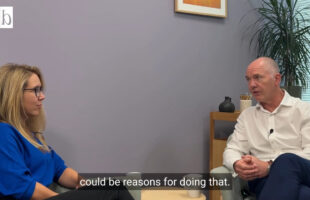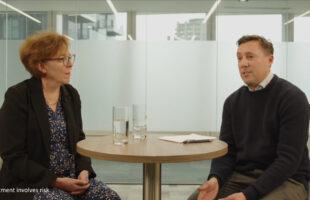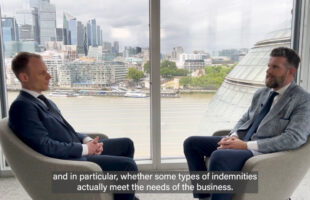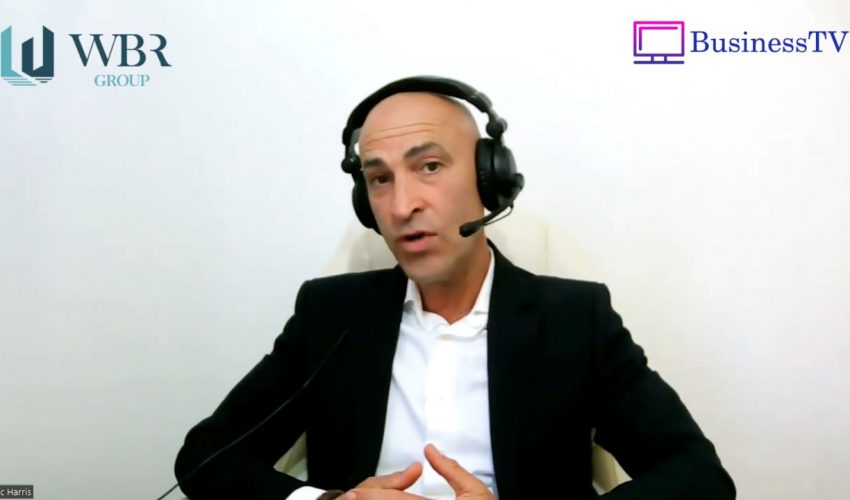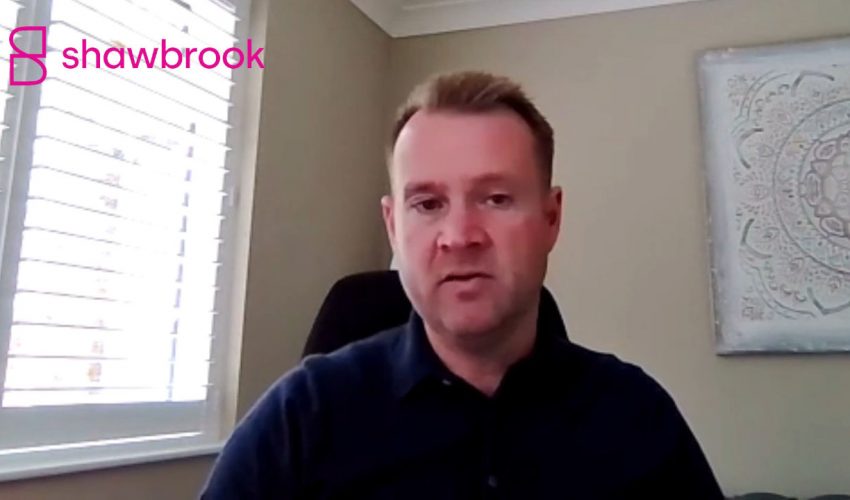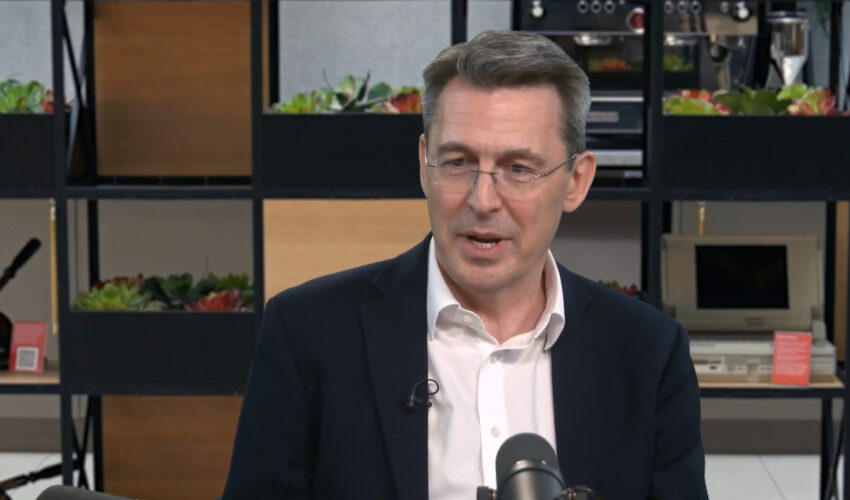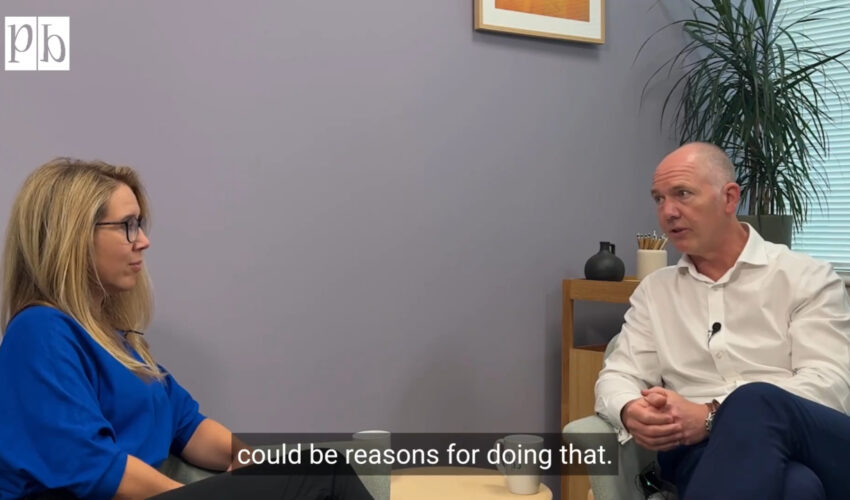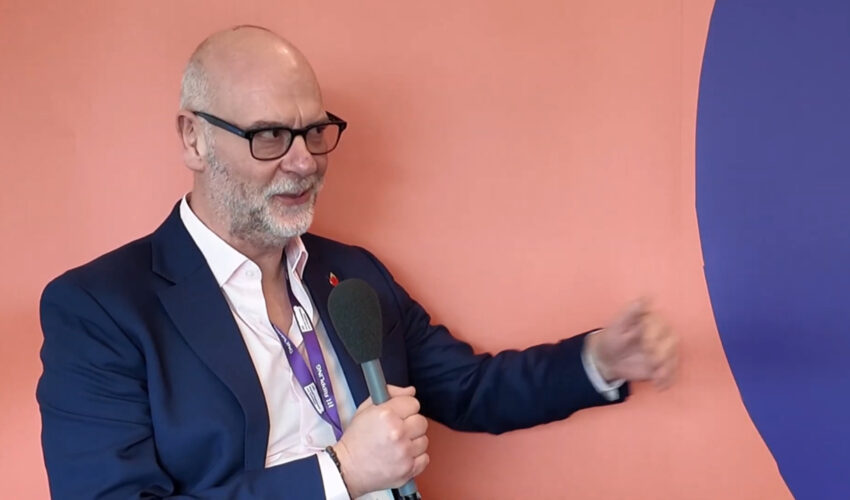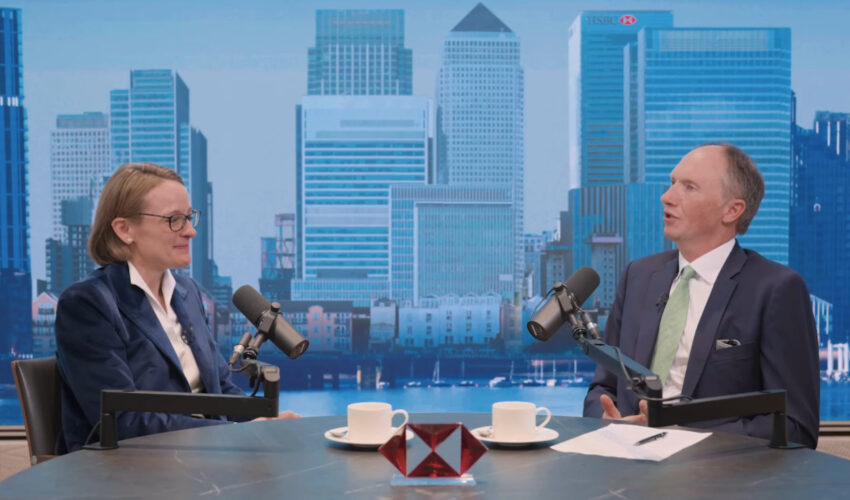
In this interview, Marc Harris chats with Oliver Wilson of Shawbrook to discuss funding the sale of your business to an Employee Ownership Trust (EOT). Oliver gives the lenders’ perspective on what they are looking for from the borrowing company, he gives insight into what percentage of the value of your business you can realistically expect to extract on day one of the sale, and runs through the options available as the deal matures. As you’ll discover, there is much a company can do to improve their chances of raising finance, and the terms of each deal are often customised and flexible.
Use the Chapter links below to travel to specific places in the conversation
Introduction: Shawbrook Bank and my guest Oliver Wilson, Managing Dirtector
Ch 1. Give us an overview of Shawbrook Bank, if you would please?
Ch 2. The two main ways of selling the business to an EOT
Ch 3. Let’s explain how funding works by using and example of an EBITDAR of £2Million
Ch 4. When do you and your team at Shawbrook get involved in the process?
Ch 5. What factors are you using to decide whether an evaluation is credible?
Ch 6. Commitment to selling while at the same time commitment to staying
Ch 7. Preparing the business when applying or an EOT loan
Ch 8. How many months or years worth of good quality financial reporting do you like to see?
Ch 9. Typically, how long does it take to get the funding?
Ch 10. Can the structure of the loan be revised in time?
Ch 11. Collaboration between Lender, the Owner and the EOT?
Ch 12. Are there any common problems that can prevent the sale?
Ch 13. How does a business owner begin a conversation with Shawbrook?
Ch 14. This is Shawbrook’s specialty
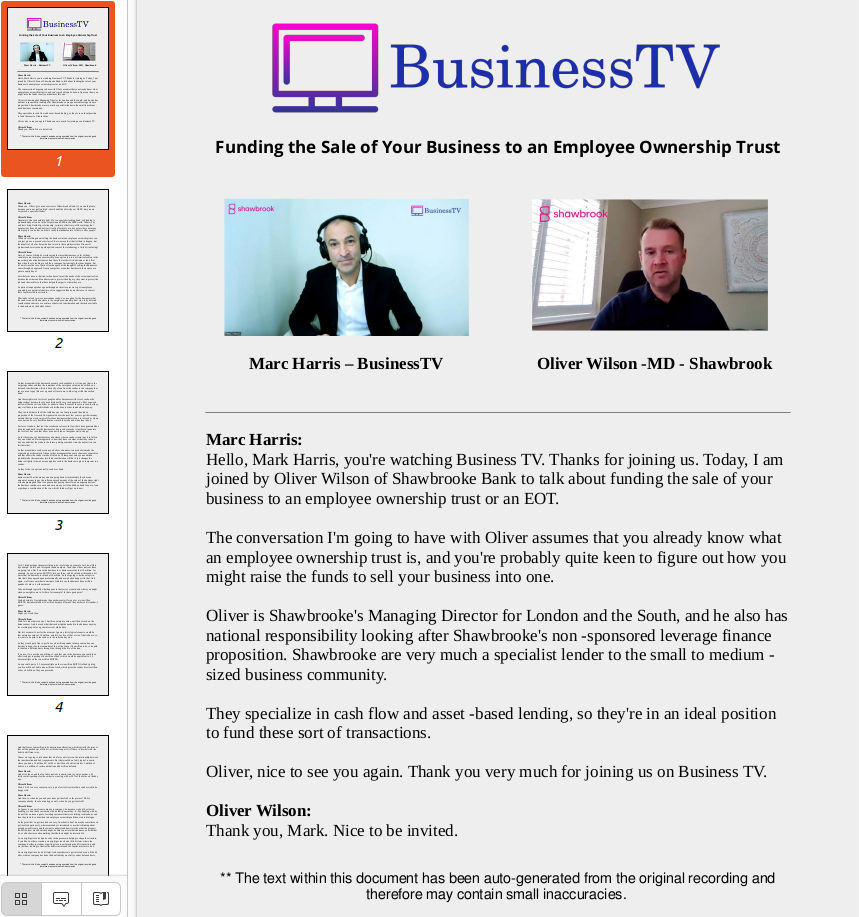
Funding the Sale of Your Business to an Employee Ownership Trust
** The text within this document has been auto-generated from the original recording and therefore may contain small inaccuracies.
Marc Harris:
Hello, Mark Harris, you’re watching Business TV. Thanks for joining us. Today, I am joined by Oliver Wilson of Shawbrooke Bank to talk about funding the sale of your business to an employee ownership trust or an EOT.
The conversation I’m going to have with Oliver assumes that you already know what an employee ownership trust is, and you’re probably quite keen to figure out how you might raise the funds to sell your business into one.
Oliver is Shawbrooke’s Managing Director for London and the South, and he also has national responsibility looking after Shawbrooke’s non -sponsored leverage finance proposition. Shawbrooke are very much a specialist lender to the small to medium -sized business community.
They specialize in cash flow and asset -based lending, so they’re in an ideal position to fund these sort of transactions.
Oliver, nice to see you again. Thank you very much for joining us on Business TV.
Oliver Wilson:
Thank you, Mark. Nice to be invited.
Marc Harris:
Thank you. Oliver, give us an overview of Shawbrooke Bank, if you would please, because you’re not really a high -street bank like a Barclays or HSBC, but you are very much a specialist lender.
Oliver Wilson:
Absolutely. You’re absolutely right. We’re a specialist lending bank, and lending is predominantly all we do in the corporate and SME in the SME world. What we try and do is bring flexibility, relationship, certainty of delivery, all those things that people want from a bank, deliver it really effectively at a size point where not many other people can do that, and that’s really the fundamental of what we offer people.
Marc Harris:
When we’re talking about selling the business into an employee ownership trust, can you just give us a prosaic overview of the two ways that that is likely to happen, but the benefit of all of us here who don’t work in these giddy worlds of financial products and services and perhaps find some of the terminology a little bit confusing?
Oliver Wilson:
Sure, of course. I think it’s worth saying that most businesses or a lot of them certainly come to employee ownership as an option in a sort of iterative fashion in the sense that quite often businesses don’t have that as their first decision or their first idea when they’re looking to sell their company. Increasingly, that does happen, but it’s not always the case. Quite often the spark or the thought of selling the businesses come through an approach from a competitor or another business in their space or a private equity buyer.
For whatever reason, that transaction doesn’t meet the needs of the owners quite often because the owners and founders want to protect their legacy, they want to protect the jobs and the workforce that have helped them get to where they are.
So quite often people have gone through an iterative process to get to employee ownership as a potential structure, often suggested then by an advisor or a contact that’s familiar with the structure.
That tends to lead to two conversations really. So one option for the business is that the vendor can sell the business to the employee ownership trust via a fully deferred consideration structure or a mixture of deferred consideration and the cash available to the business on the balance sheet.
So that means that if the business has some cash available to it, it can pay that to the outgoing vendor and then the remainder of the enterprise value can be settled on a deferred consideration which is basically a loan from the vendor to the company that says you can repay this over a period of time to me in order to get this transaction done.
And that might work for lots of people and for businesses with lots of cash on the balance sheet because they’ve been historically very cash generative. That can work really well because it can allow a vendor to take off some of the excess cash that they may well have taken as dividends or distributions to other shareholders anyway.
They can take that cash off the table day one in a lump sum and then take a proportion of the free cash flow generated over the next few years to get their money out and that can work very well for those businesses that sits on a lot of cash or where a vendor can be very flexible about how much they take and when they take it.
For lots of vendors, that isn’t the case because free cash flow that’s been generated has been invested back into the business for its growth or maybe it just doesn’t generate the levels of free cash that allow a vendor to take a lump sum out in one go.
So for those types of businesses or a business where a vendor wants to exit in full on day one or has a different approach to how they have to balance what they take on day one and what they take in the future, putting some debt into the transaction can facilitate that.
So that means that a vendor can use a debt or a business can use debt to make the acquisition purchase much like any other management buyout or business acquisition and that allows the vendor to take a little bit of a lump sum on day one and then probably take the remainder into third consideration still but it just changes the balance slightly if there’s not enough free cash in the business to give a lump sum to a vendor.
So they’re the two options really, vendor or bank.
Marc Harris:
business itself has the money on an ongoing basis or immediately they have an amount of money to pay the seller an agreed amount of the value of the business right at the beginning and then it’s a question of paying the seller on an ongoing basis as the business continues to work and earn money or it’s funded by a bank loan or a loan or perhaps a combination of the two which I think we’ll get on to now.
Let’s, I think perhaps the easiest thing to do is let’s take an example. Let’s do all this by example. So let’s and let’s speak round numbers. I don’t know how realistic these are going to be. But if we said a business is, is businesses value that 10 million, for example, So you’ve got an EBITDA, let’s say three, and it’s valued at three and a bit times that. So business is valued at 10 million. So that’s going to be the sale price. And that’s been agreed upon professionally, and everybody’s happy with that. And again, we’ll come onto that in a minute. And let’s say the business has a million pounds of cash in it at the moment.
Take us through typically what happens in that sort of scenario and where you might when you might come in. Is that a fair example? Is that a good point?
Oliver Wilson:
Yeah, absolutely. It might make the numbers easier if we go for a two million EBITDA business valued at 10 million because it’ll make the numbers a bit rounder, I guess.
Marc Harris:
Right, yes. Good idea.
Oliver Wilson:
Yeah, let’s take that scenario. 10 million enterprise value, a million of cash on the balance sheet. And it may be that that cash might be needed in the business anyway for working capital as a general sort of cash bubble.
But let’s assume it’s not for the moment. I guess a fairly typical scenario would be that enterprise value of 10 million, and let’s say five of that or six of that is due to, is, is, wants to be paid to the vendor, to the seller on day one.
So they would quite like to get five or six million pounds in lump sum on day one, but they’re happy for the remainder of the, of the four or five million to be, to be paid to them on a deferred basis through the, through the life of the loan.
If we use, if we use the one million of cash that was in the business, you could then effectively put in perhaps five million of debt, which would be equivalent to 2 .5 times multiple on the two million EBITDA.
So you could put in 2 .5 times multiple on the two million EBITDA of debt, giving you five million of debt and a million of cash, which gives the vendor his six million or her six million of day one proceeds.
And that leaves four million to be deferred consideration, which typically the term of that will be pushed out a little bit, a little bit longer. Or it’ll have to interact with the debt in a different way.
I know we’re going to talk about that a bit later, a bit later on the relationship between the consideration and debt repayments. But that would be a fairly typical scenario where you had a 10 million EV with 5 or 6 million of debt in it and or 5 million of debt in it, a million of cash contribution and 4 million deferred.
Marc Harris:
And all of those, and that’s a fairly realistic scenario. And in your experience, it’s fairly realistic perhaps for the owner to want to get 40 or 50% of the value on the day one.
Oliver Wilson:
Yeah, 50 -50 is a very common, very typical sort of structure that a vendor would be happy with.
Marc Harris:
And then, so when do you and your team get involved in the process? Does a company already, they’ve already got, well, when do you get involved?
Oliver Wilson:
So I guess it can vary from company to company. So because we don’t do clear in banking, we don’t have customers who do their general day -to -day banking with us. It’s not like we have a pool of existing customers that we’re talking to this about, and then they look for a transition into employee ownership and then start to dialogue.
So the point that we get involved can vary from deal to deal. So maybe sometimes we get involved quite early, where somebody is introduced to us who’s thinking about going down this route and they want to understand how it works, what the prospect looks like, how much debt they might be able to put into their business, and whether it’s a valid structure and something that Shorbert might be interested in.
So we might get involved quite early in the process in helping to shape the structure, if you like. In other occasions, we might get involved a little bit later, where the company is either just about or getting close to performing the EO transaction, and are just now looking to finalise the debt structure and the capital structure to do it.
So we might get involved a bit later. And sometimes we get involved even a little bit after, where a company has done the deal initially on a fully vendor deferred basis, and has then decided actually to put some debt in after the fact, in order to take that lump sum off the table.
And I guess that flows all the way through to maybe two years down the line, where a vendor’s done a deal, again, all on vendor deferred, but two years down the line has decided they want to accelerate that little bit and put some debt in.
So it can be very early to, just after the transaction, to a couple of years after the transaction. But I guess typically we’d get involved in the three to six months prior to the transition occurring.
Marc Harris:
And is that typically the period of time, then when the company is going through the process of getting a formal evaluation? And if so, how closely are you, I mean, obviously, you must be looking at that very closely, I suppose, but how closely do you look at tha and what factors are you using to decide whether that evaluation is credible? in your opinion.
Oliver Wilson:
Yes, I think there’s a mixture of things there. We will typically do external financial due diligence anyway. Most of these transactions that we work on, if we’re providing debt, we will require a third party to go in and do financial due diligence on the business to make sure that everything is what we think it is, the information is good, all that kind of stuff.
That dovetails quite nicely with the valuation that’s going on because all of the transactions have to have an independent valuation done anyway. We’re combining our assessment of the revenue quality, the sustainability of the earnings, the free cash flow generation and the ability of the business to service the debt, overlaid with an assessment of the enterprise value and how that sits.
I guess there’s things we’re thinking about is what’s the buffer between the enterprise value, multiple and the amount of debt that’s going into the business. For example, in a business that’s only valued at say three times EBITDA for some reason or another, I would be much less comfortable putting in.
two and a half times EBITDA as debt. In fact, I wouldn’t be very comfortable at all, versus the same sort of a different business that’s valued at six times or seven times or eight times EBITDA. I might be more comfortable doing a little bit more than two and a half times multiple on the EBITDA because the buffer between the debt and the enterprise value is a little bit bigger.
So that’s what we’re, you know, they’re the sort of dynamics that we might be looking at. We’re also looking at how realistic the valuation is. So you’re looking at the the valuation that’s been done, the comparables that have been used in that, and then overlaying that with our experience of the market and other transactions that we’ve done.
We do, you know, we work with a lot of businesses doing acquisition, finance and management buy-ups. So we’re overlaying our experience of those types of transactions to give us a flavour for whether we think that the multiple being being talked about and mooted as the transaction is kind of in line with our market expectations and then assessing that in the context of the business and the debt.
Marc Harris:
And just bringing you back to the options that the company has just quickly as well. Because even if you have, and you can talk us through this, explain how this works, even if a business is drowning in cash, which will be some businesses of course, but even if that is the case, it’s still financially quite beneficial for the business to assume a bit of bank debt as well at the same time, isn’t it?
And can you explain why that would be?
Oliver Wilson:
It can be. And I think it’s fair to say that most of the time, you know, the reason for putting debt into the business is driven by the seller, the vendor rather than rather than the business, because the business doesn’t make a decision.
It’s a management, you know, there’s a management team and a management board that make decisions about the business. And I guess the advantages to the business of having that are that quite often the interest charged on loans might be less than vendor deferred interest, albeit a lot of vendors are quite generous.
And so that’s not always a given, I suppose, that that’s the case, but that can be a consideration depending on who the vendor is. and how they want to structure their deferred consideration loans. I think what it does do is it brings a good level of discipline and kind of governance to the business because the level of reporting required if you’re going to have debt, senior debt in a business means that you’ve got to be able to report very clearly, you’ve got to have good quality MI, you’ve got to have good KPIs, you’ve got to have good oversight of what you’re doing.
And actually that’s quite a good discipline for a lot of businesses. But I think it would be fair to say that it’s typically the transaction itself that requires the debt rather than a desire from the business to have debt to do it for some advantageous purpose.
Marc Harris:
Right, right. I see. So that decision is more vendor driven. What is your view on the decision that the business owner is taking in terms of how much equity, if any, they are intending to keep in the business because viewers who will understand what an EOT is They’ll understand that it’s something that you can you can sell your entire business from day one into the EOT Or you can just decide to to keep some equity in that as long as it’s less than 51% So ultimately the EOT is that is controlling the business and not you the exiting vendor But this is an interesting cultural question and issue isn’t it because on the one hand Commitments to the process of the EOT is fantastic and that would in that could indicate That one is quite happy to release all of the business on day one into the employee ownership trust But at the same time commitments to seeing the business through the next four or five years while this debt is being paid out Is also important and I guess from your point of view So how do you how do you square that circle and and look at the nuanced issue that that is?
Oliver Wilson:
Yeah, it’s an interesting question Mark and I guess it’s it’s in many cases You know both scenarios can be fine and both scenarios can be a problem It just depends on the individual on the individual cases, but I think it’s fair to say that Almost all EOT transactions are either 100% or 51% There’s not much in between For obvious reasons that people tend to do that the maximum or the minimum in terms of requirements and I think a lot of that is about The then the journey that the vendor has been on already and the journey the business is going on and it’s staged within that so I guess if you have a And a founder owner who’s been in the business for a very long time built it very successfully and Their plan is retirement and in fact the business is the plan strategically for the business is for it to continue Broadly doing the same thing with a management team who probably be running the business pretty successfully day to day for the For you know a period of time beforehand It’s very reasonable that that sort of vendor might want to do 100% transaction and sell the entire business to the EOT.
It’s relatively low risk for a lender because nothing much is changing in terms of the day -to -day management and the transition. There’s no changing strategy, there’s no changing people particularly.
But even though they might be selling 100% of the business to the EOT, chances are they’re not getting all of their money on day one. So they’re still invested in the success of the business by the fact that they will typically be owed some deferred consideration that of course they have a vested interest in ensuring the business is able to pay.
So typically you’ll see those outgoing vendors acting as chairperson of the business or in some non -exec type capacity. So that can work really well. Similarly, there’s other businesses where perhaps the business still has, still on its journey, still on a pathway to doing something, there’s still some strategic direction in the business that people are excited about.
Maybe there’s a secondary. transaction ahead in the future where maybe the business will come back into private ownership. Who knows? And it’s very typical then for vendors to say, well, I want to, you know, engender the culture of employee ownership within the business.
I think it’s a great thing to secure the jobs of the people who help build the business. But the strategic journey isn’t over and I want to be a part of that. And then quite often we can see these 51% transactions where owners will take a little bit of money off the table.
Why shouldn’t they? They’ve built successful businesses that enable them to do it. But also want to continue to have a commitment to the business and to help drive it forward on its next stage of growth, whatever that might be.
And in that scenario, that’s equally acceptable as well. So there’s different rationales and motivations. And I guess with all of these things, and this isn’t just for EOTs, this is for any type of transaction really. But for us as a specialist lender serving the SME market, almost every transaction we ever do is really just about the people that are in that business. You know, we’re dealing with SMEs where, you know, they’re not big corporate machines where the entire management team could change tomorrow and the business would just, you know, continue to, continue to tick along and roll over nicely.
Yes, of course, we have to understand the business and why it exists and its USPs and how sustainable it is and all that sort of stuff. But fundamentally, what we’re doing is backing a management team.
We’re backing a team of people who’ve said they’re going to deliver something and we are putting our trust in them to deliver that, you know, with our help along the way. So for us, it’s very much about understanding the motivations of the vendor, the quality of the management team to what extent there’s a change in the day -to -day operations to have that management team already been brought up the scale and be part of the management board on an ongoing basis.
Or is this a big step up for them? So that’s all those dynamics between the management team going forward and the management team that’s been before and the vendor’s motivations and then the commitment to the structure in terms of the extra layer of governance that’s required within an employee -owned transactions where we would expect to see a board of trustees, or there will be a board of trustees, I guess we’d expect to see some independence within that, where we see an independent trustee sitting on that board that can offer challenge externally and hold the management team to account for delivering the strategy of the business and that kind of thing.
So I think it’s really just about for us understanding the people, the motivations and the dynamics between the management teams and the outgoing vendors to make sure that we understand all of those aspects and are comfortable with them.
Marc Harris:
Yeah, a recurring theme always with mid -market companies is of course that commitment of the people who are running the business. Businesses are always in the mid -market, entirely a result of the efforts of the people running them. When it comes to then looking at the governance of the Employee Ownership Trust because ultimately that’s who you’re lending the money to isn’t it? You’re not you’re not actually lending the money to the outgoing vendor You’re lending the money to the to the EOT When you’re talking there about making sure that that’s all been set up correctly that there’s the right people in place that there’s You know a challenge a management structure that is there in a competent format and then and an Authoritative format to challenge the interests of the outgoing seller if that is in the best interests of the business to do so and how do you say if I’m a I’m a company director and I’m thinking about setting up my You know, I’m thinking about going down this road funding of course for me No, probably as likely to be critical. I want to make sure if I’m coming to you I want to make sure that you are going to look at me in the most favorable light that you you know You think that we’ve got all our ducks in a row What what sort of what sort of things can I do then in terms of the EOT structure?
What sort of things do you look for concrete things, you know empirical things that are there in the EOT structure that give you confidence that we’ve done that properly?
Oliver Wilson:
Yeah, I think that I think there’s two parts to it really There’s there’s a business angle to it and there’s a kind of governance and structuring angle to it So I think on the business side, I guess this will again not just relevant to employee transactions But perhaps you know equally relevant where there’s a change of management which typically there might be in these types of scenarios So you’re having a clear strategic plan and clear direction about where the business is going Most importantly is really good quality management information financial information Particularly if it’s the first time the business has taken on debt before having really good quality Finance function having a really good quality management information to be able to report on key KPIs in the business And to be able to monitor covenants and that kind of stuff that that will of course come with having debt in the business Is really important so getting getting that ready available Working before you start talking to a lender about it is probably a great thing to do and make sure that you’ve done if you have obviously we can introduce people to help with that type side of things, but that’s really important.
Marc Harris:
And then if we flip onto governance side. And just a quick question about that financial reporting, which obviously from your perspective is so important. How far back does that really good quality financial reporting ideally, I mean ideally from your perspective, it goes back from the inception of the business. But if that hasn’t been the case, because many of these companies might have expanded quite quickly and been reacting to market conditions quite quickly, etc. You know, how many months or years worth of good quality financial reporting do you like to see?
Oliver Wilson:
It’s a good question. I think I’m more about forward looking than backward looking. So we will be getting an external accountancy firm to go in and do financial due diligence. And that’s a little bit more backwards looking because that’s using history to predict the future and saying, how has this business performed historically?
And to what extent can we then believe what’s going to be what’s being predicted in forecasts or for for the business going forward. So we have a piece of financial diligence that looks at the backward looking story and the information.
I think the important thing is that even if you haven’t had, you know, super brilliant MI, you know, really all singing, all dancing, integrated P &L, balance sheet, cash flow, month by month, you know, forecasting, et cetera.
Even if you haven’t had that historically, you will need it going forward. So it’s never too late to do it. And if you’re going to put debt in, you must. So even if you haven’t had amazing historic financial information, it’s more about what you’ve got today and what you will have going forward and being able to demonstrate to any lender that you can report meaningfully on how the business is performing.
You can provide information to them that allows them to and us to calculate covenants and monitor the business effectively and that the information is accurate. So it’s not a huge problem if the information hasn’t been produced in a certain way historically because for many businesses, if you haven’t got debt, you produce information that helps the management team run the business in the way that they’ve chosen to do that.
But it’s more about getting it in a state going forward that you can do that.
Marc Harris:
And imagine a scenario, because I guess this is the logical question, imagine a scenario where one’s got a business that has done all that. They’re in a market sector which is poised to continue to do well. And all of those things are clear and all the boxes have been ticked as it were. How long does a process like this take and what sort of engagement is required from the management team to work with you? How onerous is all of that process? How long does it take to get the funding?
Oliver Wilson:
Yeah, good question. I think it varies hugely. One of the things I was just going to mention on the information side is, and this can delay things if people haven’t thought about it ahead of time.
As I mentioned previously, the Board of Trustees, that sort of sits above the management team in a way as an oversight business that’s appointed by the trust company to protect the interest of the beneficiaries of the trust, which is the employees in this scenario.
And I think that’s a key cultural shift for us as a lender in looking at that board of trustees and making sure that there’s some independence in there because we’ve found our own business where typically perhaps one or two paid people have made all of the key decisions in that business over a long period of time without really any challenge or being held to account for those decisions.
It’s an important understanding both for them and for the structure to work, but they do have that extra layer of governance built into the structure. So I guess typically we would want to see both the board of trustees including some key people from within the business, but also some at least one independent trustee sitting on that board of trustees to give some oversight and challenge to the management team of the business as part of that transition into an employee owned business.
Marc Harris:
Because otherwise you’re in a scenario where you’ve got a sort of nepotistic situation going forward where the board of trustees of the EOT are actually just friends or family, perhaps of the exiting seller. And there’s just merely a veneer of independence but there actually isn’t any. So, okay. So it’s useful.
Oliver Wilson:
And that’s just about the governance of it. It may be that that’s appropriate and that actually works perfectly well in practice but it’s important to have someone independent in there to just make sure that there’s that oversight of governance to do in that.
Marc Harris:
Yeah, and I suppose in the ideal world, the exiting vendor, I mean, they have taken the decision to go down the EOT route, not only for the great capital gains tax relief that one gets from it if you sell a business in this way but there has to be an element of wanting that, wanting to culturally buying into the concept of transferring the ownership of the business onto the employees. So they would ideally want the exiting vendor would want to see somebody in there who has a different hat on and a different perspective to their own and who is genuinely there with regards to running the EOT for the benefit of the remaining employees. But again, it’s interesting to see how nuanced it is and also from your perspective, how nuanced it is from the bank’s perspective that you do very much look at the human element of the entire process from competent management teams knowing what they’re doing, if they’re gonna be then left with running the business without its incumbent pilot as it were. And also wanting to make sure that the EOT has got the right governance in place. that you mentioned quickly at the beginning when we were talking about the funding for this. And I think it’s something worth just following up on is that this doesn’t necessarily have to be a one-off transaction, does it? So can you explain how it would work further down the line both from the existing, yeah.
Oliver Wilson:
Yeah, no, and it’s a really good point, actually. And I think this is really important for us and as part of our strategy as a lending organisation in terms of what we do as well, because it’s very easy to just do the transaction that’s in front of you today and be very happy with that and then move forward.
But ultimately, we’re an organisation that wants to grow and we recognise that the best way to do that is to grow with our customers and target customers who want to grow as well. So very important and central to our strategy is not just working with businesses to finance a transaction on day one, but it’s about following that through with other stuff beyond that.
And that might very typically be something like an EOT where we provide some day one financing and typically the deferred consideration due to a vendor will be subordinated and that means that effectively sitting behind the bank debt in terms of priority of repayment because most banks, ours included, is not super comfortable with the idea of vendor having all of their money off the table before the bank has had their money repaid because then that balance of interests and that alignment of interest starts to get a bit out of kilter.
So we want to make sure that a vendor is still due some money and that keeps them motivated and invested in the business and that we’ve obviously got our money into that transaction as well. But that doesn’t mean that over time, depending on the balance of deferred and day one consideration that was agreed on on that transaction, that doesn’t mean that if the business performs to plan it’s still generating free cash flow over and above the debt service, things are going well, that 12, 18, 24 months down the line that we can’t sit around the table again with the vendors, they actually perhaps it will be beneficial to the business to accelerate some of your deferred consideration and perhaps we could put in a little bit more debt.
You’d probably repaid some debt over that time already, hopefully the businesses continue to perform well and perhaps ahead of budget or something like that. We might well then consider putting in a bit more debt to accelerate vendor deferred consideration. It’s unlikely that we’ll allow the vendor to take all of the money out whilst the debt still remains outstanding until a bit later in the sort of process. So it simply won’t be all of the money. But in the example that we talked about before where the vendor had had 4 million of deferred consideration, it might well be that we were able to put in extra million of debt to allow that to be taken by the vendor, maybe a million and a half, something like that, where they still had two, two and a half million in but could accelerate their deferred consideration through some additional debt.
So that’s very much something that we would consider. and is part of our strategy, I guess, to make sure that we continue to lend money to growing businesses.
Marc Harris:
Is that a potential plan that is often looked at with the client at the time of structuring the original finance? Or is that a conversation that is had in some way, shape or form? Or does that only ever transpire later on when you’re comfortable that everything is going ahead as it should do?
Oliver Wilson:
Yeah, it can be a mixture of all of those things really, and a lot of it comes down to what the balance of the structure is on day one.
So the more aggressive the debt structure is on day one, the less flexibility there probably is to build in commitment to allow acceleration of deferred considerations or anything else that sits within that business because we’ve put a more aggressive debt structuring on day one.
Where the debt structure is much more conservative on day one, that allows greater flexibility. to give a little bit more visibility, I suppose, to those types of arrangements. And whether they’re funded by cash in the business, that we just are comfortable, sort of flows out of the business to pay some deferred consideration a bit earlier than planned, subject to cover and compliance, of course, as is always the case, or whether that can be a little bit more debt.
So a lot of it will depend on the overall balance of the transaction and the balance of risk, I suppose, in the front end versus what’s right.
Marc Harris:
And then that leads me to think of another question, which would be because essentially you’ve got three, you’ve got three parties involved in this transaction, you’ve got the seller, you’ve got yourselves and you’ve got the EOT. And of course, using the example that you’ve just given, I can see that there could be a little bit of give and take depending on how each party wants to wants to proceed. Do you then typically, when you’re structuring these deals, is it sitting down and having a sort of almost like a three way conversation with it? Does everybody sort of sit around the table and say, OK, well, you know, in my ideal world, this is what I’m getting out of it. And then the EOT says, well, I want to get this out of it. When you’re saying, well, yes, but we also need to see things happen in this way. And then it’s a little bit of a negotiation. It’s a little bit of the conversation where everybody’s trying to find that happy common ground. Is that how it can work?
Oliver Wilson:
Yeah, quite often it is. It’s a very kind of collaborative approach. And we try not to dictate too much the structures and how this how this wants to operate. Because ultimately, one of the reasons that we exist and we we, you know, we are placing the market is such that we are providing more flexibility and we’re trying to provide a balance across all of those stakeholders, as you suggested, that meets with their requirements better than than some other banks might.
And that that’s really, you know, fundamentally what we’re about. So very much will be a conversation between the vendor. you know, the business is represented by the management team, so it’ll be the management team of the business, the vendor and us talking about, you know, the balance of interests and what people want to achieve.
And then looking at that compared to the strain it will or won’t put on the cash flows of the business versus the level of risk that as a lender we’re comfortable to take. So yeah, very much it’s a collaborative conversation to come to an acceptable agreement.
I’m not saying that every time we get to something that absolutely meets everyone’s needs 100%, but certainly we start with that point. The idea is we start at that point and say what does everyone want to achieve out of this and we get as close as we can to that.
Marc Harris:
In your experience, which is far more considerable than most, have you ever had situations or are there anything that sometimes will trip these deals up? from the vendor’s point of view, even if the company is in good condition and you as the potential lender are happy with all that you see in terms of governance and financial reporting. Are there things, is there anything consistently that can come out of left field that people should be aware of?
Oliver Wilson:
I’m not sure there’s anything consistently that trips him up. In many ways, the execution risk on these types of transactions is relatively low because all of the parties are known to each other and operating in a broadly friendly environment. So you don’t have the adversarial construct that you would typically in an acquisition or a managed buyout where one party is trying to make sure they get the most money and the other party is trying to pay the least money for it.
There’s a sort of fairer, more balanced approach to these types of transactions. But that does mean that as the lender you have to be absolutely comfortable with the valuation. And I think particularly in this type of market at the moment where perhaps the availability of a trade buyer at a strong multiple is a bit lower, the availability of private equity money, acceptable multiples to a vendor might be a lot lower, certainly will be.
And I guess it wouldn’t be a huge leap to say that there will be businesses out there who with vendors who’ve been looking to exit and suddenly the trade sale and or a PE sale at a price point that they’re comfortable with is no longer viable.
We’ve got to be mindful that doing an EOT transaction at an effectively inflated multiple may happen and those transactions will be out there looking it’s not the majority by any stretch of the imagination. 99% of them will be all already strong transactions that are done for the very right reasons, but we’re always mindful of those that the odd one or two that aren’t where those inflated valuations fill a gap between a vendor’s expectations of what they wanted to get for the business that’s not. no longer viable. So that’s something that we’ve always got an eye on. But other than that, other things that can trip them over, I guess occasionally we see suddenly a trade buyer does come out of the woodwork and that becomes a better option, but not often because often people have been down that path already and come to the entity having already explored other options.
So I wouldn’t say there’s anything consistently that causes challenges for these types of transactions. I think they’re quite a big commitment for businesses to make and to go forward with. And once people have made those commitments, typically they tend to happen.
Marc Harris:
Yeah, absolutely. And indeed, perhaps as the whole concept of EOTs becomes better known, more people will be entering into the EOT from the get-go. And as you said earlier, often they’re an iteration of people looking to sell the business and then that taking too long, or adversarial conversations or dealings taking place that aren’t necessarily in people’s benefit and then people are learning about this alternative structure. Obviously, if I was selling a business, you’d be a wonderful person for me to sit down and have a chat with. How does that work in terms of taking things forward for companies who are in a position now where they are ready to have a chat with somebody like yourself Oliver? You’ve got, I mentioned at the beginning of the conversation that, you know, you look after London and the South and the Southwest, I believe, but you’ve got to, you sure you’ve got a national team. How does, how is this, what’s the level of sort of people, your skills set on the ground to have a chat with customers and how would people take things forward?
Oliver Wilson:
So all of the directors that are on the ground out talking to businesses are fully sort of conversant in EOT structures and almost everyone will have transacted at least one of those over the last kind of couple of years as the structures become more prevalent.
So we have a network of director and senior directors out in the market talking to businesses, talking to advisors about these types of transactions. And that would typically be the first step with a company who was interested in talking to Shawbrooke was that, but they’d reach out to someone like me or one of the other people they know in the Shawbrook network and have an initial conversation.
And I guess, you know, you asked about timings as well and how long things take. I guess typically we operate at the speed that the customer wants to operate at because we have a flatter credit structure, a fairly quick process.
I would say it’s rare that anything we do causes a delay to a transaction and we typically work at a faster pace than the transaction itself is able to work at. But I guess things that take time can be financial due diligence. So that will normally take a few weeks to get booked in and what have you. So, you know, I guess start to finish if you wanted to do it quickly. You could do it in six to eight weeks, but most of them take around eight to 12 is fairly typical.
But the way we operate is running a two -stage… credit process. So that means we’ll have an initial conversation with a prospective customer, find out about the business, find out about the management team, look at some of the financials and then do a brief pass through our credit process with a short summary of the transaction to get all the key stakeholders engagement on that transaction and to give appetite and any pointers of particular areas of risk we want to make sure we investigate through the decisions process.
And in doing that we share an indicative term sheet with a with a prospective client that lays out, you know, the structure of the debt we want to put in, the covenants, the pricing, all of that, all of that type of stuff.
And that gives the customer some real confidence that we can deliver. And then we would move into a diligence phase, a full credit process, which again is relatively quick. And then that would lead then into the final documentation.
But I guess for us what’s super important is that all things being equal, assuming the diligence tells us what we were expecting it to tell us that we deliver at least what we wrote on the term sheet or better.
We’re not in the business of putting a term sheet out and then delivering 70 or 80% of what was written on the term sheet. It’s very important to us to make sure that we deliver on what we’ve said we will.
Marc Harris:
And I think it’s worth reminding the viewer at this stage that because you very much are a specialist in this area, this is, this and other transactions like this, this is your bread and butter. So customers coming to you, they know that there’s you and other competent members of your team who are doing this day in, day out. This isn’t like working with perhaps a high street bank and then getting involved in the process, which is like pulling teeth in terms of speed at which they’re working. And indeed the commitment that they have to what they might be seeing as a transaction that doesn’t particularly interest them. I mean, this is worth reminding the viewer that this is what you guys do.
Oliver Wilson:
Yeah, and I think that’s a very important point actually in the sense that most of the businesses that we deal with will have a, you know, they will all have a clearing bank relationship where they’ll be in a portfolio being looked after by relationship manager, which will typically be their first port of call for these types of discussions.
And that manager will have a number of customers in their portfolio. Whereas for us, we have a dedicated team who are out purely structuring and doing debt for these types of transactions. And then of course there is an in life process as well a relationship that we build with that client through our client and relationship management teams, but our client and relationship managers are only doing debt and they have circa 15 clients in the portfolio.
So if you really think about that, at the size point we’re operating in, which I guess is typically businesses with an EBITDA of between one and six, seven million. We’re typically lending between two, three and 15, I guess typically, you know, for those sort of, in that sort of size point to have a relationship proposition based on sort of 15 clients in a portfolio where we’re operating.
where the debt bit is all you’re doing, there’s no other noise, no other banking noise that goes around it is quite rare.
Marc Harris:
Yeah and great for the owner -director because that means that there’s somebody who’s a telephone call away probably at any given point to discuss things through. Oliver, we’ve covered quite a lot. Is there anything that we’ve left out from the perspective of giving our viewers an overview of this process and how you can help? Are there any questions that I should have asked you or that I’ve forgotten to ask you or things that you would like to say that you haven’t said?
Oliver Wilson:
No, I think we’ve covered a real lot of ground though. I guess these types of structures are becoming increasingly common, rightly so and for a very good reason and it’s a big part of what we do and we love working on EOT transactions and I think it’s important for businesses that are going down this route or considering it that you get the right advice not just from the bank, that you’re working with and making sure that they understand the construct of what you’re doing and whether they’re going to lend their money to the operating company or the trust company or a combination of the two and all of the nuances of the structure and the people.
But more importantly, you’ve got advisors that are doing the same, whether that be on the corporate finance side, whether that be your accountant, whether that be your law firm that you’re working with. Having the right advice from people who are experiencing these types of structures will be money well spent in the end.
Marc Harris:
Yes, of course, important to get it right from the start, of course. So Oliver, thank you very much for taking us through this.
It’s really fascinating to understand the different elements involved, the criteria that you need to be satisfied against as a lender. I think understanding how it all plays out certainly makes it seem more tangible and indeed achievable, I’m sure, for the viewer. So thank you very much for the time that you spent with us today to take us through all of that. For you as please, get in contact with Oliver using the contacts details that you find on the screen below this video as it plays.
There’s also plenty of info there about short book banks and nice videos as well, some case study material of how they helped a company into an EOT exactly this way. So all that remains for me to do is Oliver, thank you very much for joining us on Business TV and I hope we will do something similar in the not too distant future. Thank you.
Oliver Wilson:
Thank you Mark. Yeah, it’s been absolutely great. Appreciate the opportunity to come and come and talk about this. Yeah, thanks very much.
Please get in touch with Oliver and his team at Shawbrook through this form or reach on Tele: 0330 123 1740
By clicking the “Submit” button above, you acknowledge that we will use your information as set-out in our privacy notice. If you would like a paper copy of our privacy notice, please telephone our Data Protection Officer on 0127 7751 110 or write to them at Shawbrook Bank, Sunderland, SR43 4AG, to request one.
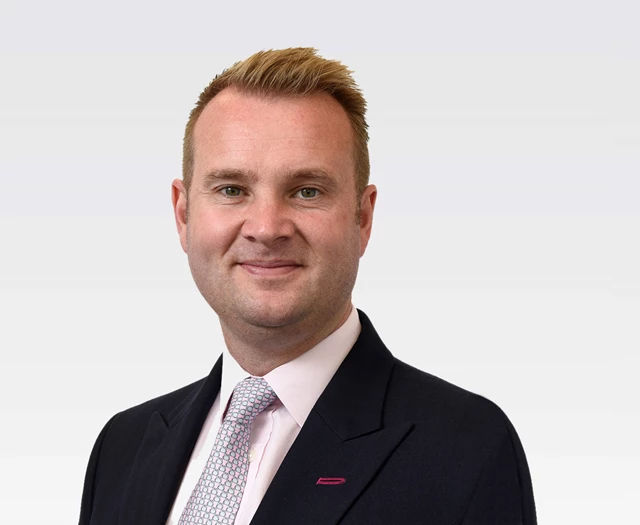
Oliver Wilson – Managing Director – London & South
Corporate Lending
With 20 years’ experience in a variety of corporate banking, alternative credit, sponsor buyout and asset based lending roles, Oliver has extensive knowledge of how to support SMEs with a range of funding needs, including transitions to Employee Ownership. Oliver also has direct experience owning and running a business so has a unique insight into the challenges facing businesses.
Oliver has been with Shawbrook for 4.5 years and is responsible for its Commercial Loan proposition, as well as leading its Corporate Lending business across the London, South and South West regions. This encompasses driving the origination and execution of both cashflow and asset based lending transactions to support growth, MBO, acquisition and refinance in the South SME market.
Specialties: Leadership, Origination, Corporate lending, Asset Based Lending, Alternative Lending, Leverage Finance, Cashflow Lending, Employee Ownership Trusts & Acquisition Finance.


Case Study: Supporting Retrac Group’s transition to employee ownership
Empowering employees, growing businesses
Whether you want to introduce an employee ownership scheme to improve engagement, provide added benefits for your staff or exit the business, we can help you achieve this transfer of ownership.
Our experienced team arrange funding for a wide range of scenarios, including acquisitions, buy-outs and restructures. We work with advisors, accountants, SMEs, sponsors and trusts and create bespoke solutions to support businesses and provide financial stability as they transition to Employee Ownership Trusts (EOT).
Find out how we helped Retrac Group accelerate their EOT here.

Making it happen, side by side
“I just felt the day we met Shawbrook they were part of our team. They were not only interested in our business but explained solutions we hadn’t even thought about.” – Andrew Fowlds, CEO of Distinction Doors
Watch this video to learn how Shawbrook’s relationship with the UK’s leading composite door manufacturer, Distinction Doors has enabled it to not only grow its business but also kickstarted its carbon neutral sustainability journey.